
Rejected Cornerstone Bible Verse
One of the most well-known Bible verses about the cornerstone is:
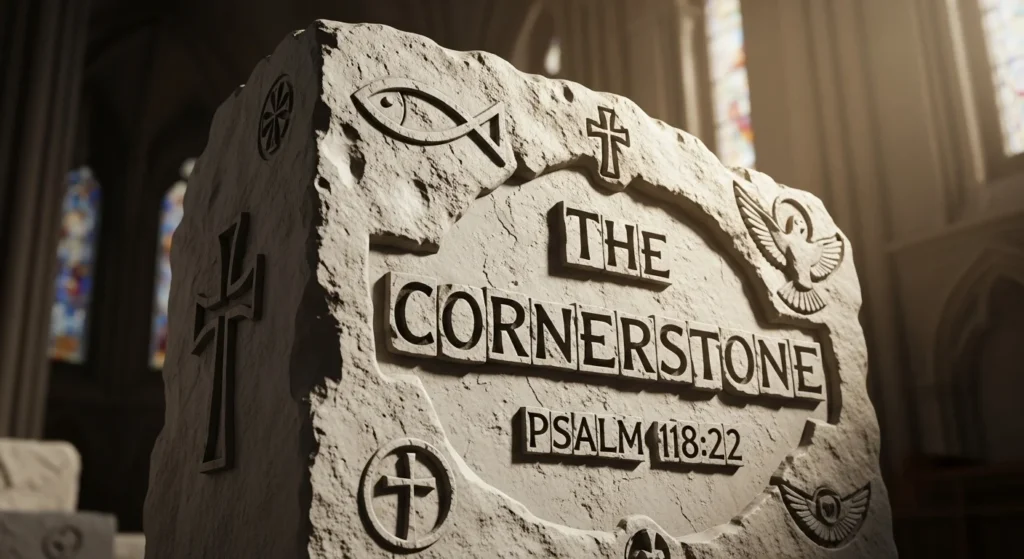
“The stone which the builders refused is become the head stone of the corner.” — Psalm 118:22 (KJV)
This verse was later applied to Jesus Christ in the New Testament. Although many people rejected Him, God made Him the foundation of salvation and His kingdom.
Jesus quoted this verse when speaking about Himself:
“The stone which the builders rejected, the same is become the head of the corner.” — Matthew 21:42
The rejected cornerstone symbolizes Christ’s rejection by many people and His exaltation by God.
What Is a Cornerstone?
A cornerstone is the first stone placed during the construction of a building’s foundation. It is carefully positioned because it helps determine the alignment and stability of the entire structure.
In a figurative sense, a cornerstone refers to something that serves as a foundation, support, or essential element upon which everything else depends.
The Bible uses the cornerstone as a powerful symbol of Jesus Christ, who is the foundation of faith for believers.
Cornerstone in the Bible (KJV)
The Bible frequently uses the image of a cornerstone to describe God’s plan and the role of Jesus Christ.
Important KJV passages include:
“Therefore thus saith the Lord GOD, Behold, I lay in Zion for a foundation a stone, a tried stone, a precious corner stone, a sure foundation.” — Isaiah 28:16
“Jesus Christ himself being the chief corner stone.” — Ephesians 2:20
These verses present Christ as the secure foundation upon which God’s people are built.
What Is a Cornerstone in a Building?
In construction, a cornerstone is a stone placed at a corner of a structure, traditionally forming part of the foundation. Builders used it as a reference point to ensure that the walls and other parts of the building were properly aligned.
A correctly placed cornerstone helped provide:
- Structural stability
- Accurate alignment
- Strength and durability
- A reliable foundation
Because of its importance, the cornerstone became a symbol of something essential and dependable.
Cornerstone Meaning in Hebrew
The Hebrew word commonly associated with cornerstone is “pinnah” (פִּנָּה), meaning corner, cornerstone, or chief corner.
In the Old Testament, the cornerstone often symbolized strength, leadership, and a foundational element within God’s plan.
When biblical writers referred to the Messiah as the cornerstone, they were emphasizing His central role in God’s redemptive purposes.
Cornerstone Meaning in Life
In everyday life, a cornerstone refers to a fundamental principle, value, or belief that supports everything else.
Examples:
- Honesty can be the cornerstone of a strong relationship.
- Trust is the cornerstone of effective leadership.
- Faith is the cornerstone of the Christian life.
Something described as a cornerstone is considered essential, foundational, and indispensable.
What Is the Importance of a Cornerstone in a Building?
The cornerstone was important because it served as the reference point for the entire structure. Builders used it to guide the placement and alignment of the remaining stones and walls.
Its importance included:
- Establishing the building’s position.
- Ensuring proper alignment.
- Supporting structural integrity.
- Providing stability and strength.
- Serving as a foundation for future construction.
Because the cornerstone influenced the entire building, it became a fitting symbol for Christ’s role in the church.
What Is a Chief Cornerstone in Architecture?
In architecture, a chief cornerstone refers to the principal foundation stone that determines the alignment and direction of the entire structure.
While modern construction methods have evolved, the historical concept emphasized a stone of exceptional importance. The chief cornerstone connected and supported key sections of a building.
Biblically, Jesus Christ is called the Chief Cornerstone because He is the foundation and unifying center of God’s people.
“Jesus Christ himself being the chief corner stone.” — Ephesians 2:20
“To whom coming, as unto a living stone, disallowed indeed of men, but chosen of God, and precious.” — 1 Peter 2:4
The Spiritual Significance of the Cornerstone
The cornerstone is one of the Bible’s most powerful pictures of Jesus Christ. Just as a building depends on a solid cornerstone, believers depend on Christ as their foundation.
“For other foundation can no man lay than that is laid, which is Jesus Christ.” — 1 Corinthians 3:11
The biblical message is that Christ, once rejected by many, became the Chief Cornerstone chosen by God. Those who build their lives on Him have a secure and lasting foundation.
Biblical Background
Old Testament Foundations
The Old Testament foreshadows the cornerstone in both literal and symbolic ways:
Psalm 118:22 — “The stone which the builders rejected has become the chief cornerstone.”
This verse highlights God’s use of the rejected to accomplish His purposes. It also points prophetically to Christ.Isaiah 28:16 — “Behold, I lay in Zion a precious cornerstone, a sure foundation…”
The cornerstone is a symbol of God’s plan, stability, and salvation.
New Testament Fulfillment
In the New Testament, Jesus is explicitly identified as the cornerstone:
Matthew 21:42 — Jesus quotes Psalm 118, showing Himself as the cornerstone rejected by religious leaders but chosen by God.
Ephesians 2:19–22 — Believers are built together into a spiritual house, with Christ as the cornerstone.
1 Peter 2:4–6 — Jesus is the living stone, rejected by men but chosen and precious in God’s sight.
The cornerstone is not merely a structural metaphor; it conveys relationship, foundation, and spiritual inheritance.
Spiritual Interpretations of the Cornerstone
1. Jesus as the Foundation of Faith
Verse: “For no one can lay any foundation other than that which is laid, which is Jesus Christ.” — 1 Corinthians 3:11
The cornerstone emphasizes that all faith, life, and spiritual growth must be anchored in Christ. Without Him, spiritual life lacks alignment and stability.
2. Rejection and Vindication
Verse: “The stone which the builders rejected has become the chief cornerstone.” — Psalm 118:22
The cornerstone represents God’s choice of what the world may reject. Christians may experience rejection, but God uses these experiences for divine purposes, turning trials into triumphs.
3. Unity and Spiritual Building
Verse: “You also, as living stones, are being built up as a spiritual house…” — 1 Peter 2:5
Christ as the cornerstone unites all believers into one spiritual temple. Unity, fellowship, and shared faith rest on Him. Every Christian is a “stone” aligned by Christ, contributing to the stability and beauty of the Church.
4. Security and Stability
Verse: “A house built on the rock will stand.” — Matthew 7:24–25
The cornerstone ensures the structure is secure. Spiritually, abiding in Christ provides stability amidst trials, storms, and uncertainties. Faith anchored in Him withstands spiritual attacks.
5. Guidance and Alignment
Verse: “So then you are no longer strangers and aliens, but you are fellow citizens with the saints and members of the household of God, built on the foundation of the apostles and prophets, Christ Jesus Himself being the cornerstone.” — Ephesians 2:19–20
The cornerstone sets direction. In life and ministry, aligning with Christ ensures believers walk in God’s purposes and maintain spiritual integrity.
Practical Faith-Based Applications
Anchor Daily Life in Christ
Read Scripture, pray, and meditate on His Word as your spiritual cornerstone.Endure Rejection With Hope
Embrace trials as opportunities for God to elevate what is rejected or underestimated.Build Relationships on Christ
Foster unity and fellowship in the Church, with Christ as the central foundation.Seek Spiritual Stability
In times of uncertainty, return to Christ for guidance, peace, and direction.Live as a Living Stone
Reflect Christ in character, service, and ministry to build His spiritual house.
Cornerstone in Dreams and Symbolism
Being rejected by builders — may signify feeling undervalued or misunderstood; God’s purposes prevail
Walking on a stone foundation — standing firm in faith and obedience
Dream interpretations should always be confirmed with Scripture and prayer.