
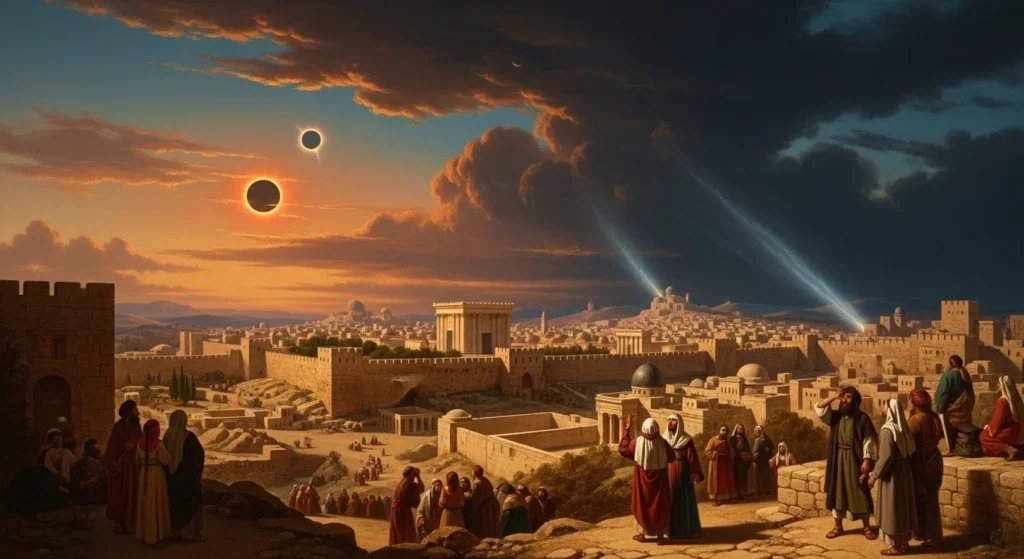
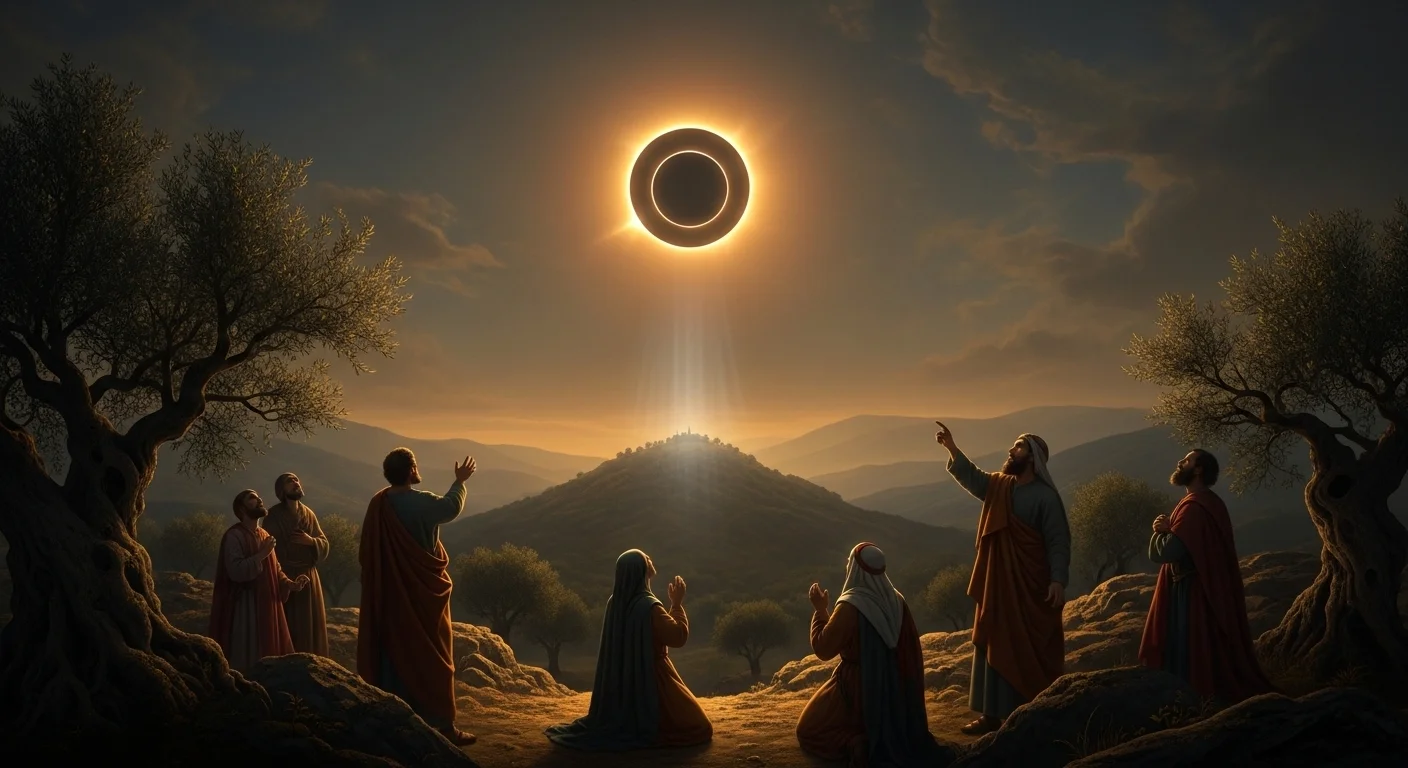
Lunar Eclipse
A lunar eclipse occurs when the Earth moves between the Sun and the Moon, causing Earth’s shadow to fall on the Moon. During a total lunar eclipse, the Moon may appear reddish, which is why it is sometimes called a “Blood Moon.”
In the Bible, lunar eclipses are not specifically explained, but the Moon is often mentioned as part of God’s creation and as a sign of His power.
Psalm 8:3 says:
“When I consider your heavens, the work of your fingers, the moon and the stars, which you have set in place.”
Lunar eclipses remind many believers of the greatness and order of God’s creation.
Solar Eclipse Today
A solar eclipse occurs when the Moon passes between the Earth and the Sun, partially or completely blocking the Sun’s light.
If you are looking for a solar eclipse happening today, the exact visibility depends on your location and the current date. A solar eclipse is a natural astronomical event and is not described in the Bible as a regular sign predicting specific future events.
Many Christians view such events as opportunities to appreciate God’s creation.
Solar Eclipse Tracker
A solar eclipse tracker is a tool used to monitor upcoming eclipses, their paths, and visibility around the world. These trackers provide information such as:
- Eclipse date
- Start and end times
- Type of eclipse
- Areas of visibility
- Percentage of the Sun covered
People use eclipse trackers to safely plan viewing opportunities and learn more about astronomy.
Solar Eclipse Time
The time of a solar eclipse varies depending on:
- Your geographic location
- The type of eclipse
- The date of the event
Solar eclipses can last from a few minutes to several hours from beginning to end, although totality typically lasts only a few minutes.
To determine the exact eclipse time, observers must consult an eclipse schedule specific to their region.
Solar Eclipse and Lunar Eclipse
Solar and lunar eclipses are both celestial events involving the Sun, Earth, and Moon, but they occur differently.
Solar Eclipse
- Moon moves between Earth and Sun.
- Sun appears partially or completely blocked.
- Occurs during a new moon.
Lunar Eclipse
- Earth moves between Sun and Moon.
- Earth’s shadow falls on the Moon.
- Occurs during a full moon.
Both events demonstrate the precise order of God’s creation and the laws governing the universe.
Genesis 1:14 says:
“Let there be lights in the vault of the sky to separate the day from the night, and let them serve as signs to mark sacred times, and days and years.”
Solar Eclipse vs Lunar Eclipse
| Feature | Solar Eclipse | Lunar Eclipse |
|---|---|---|
| Cause | Moon blocks the Sun | Earth blocks sunlight from reaching the Moon |
| Moon Phase | New Moon | Full Moon |
| Visibility | Small path on Earth | Visible from much of Earth’s night side |
| Duration of Totality | Usually a few minutes | Can last over an hour |
| Safe Viewing | Requires eye protection | Safe to view directly |
The primary difference is that a solar eclipse affects the appearance of the Sun, while a lunar eclipse affects the appearance of the Moon.
Solar Eclipse Diagram
A solar eclipse occurs when the Moon comes directly between the Sun and Earth.
Simple Diagram:
SUN ---> MOON ---> EARTHThe Moon’s shadow falls on part of the Earth, causing observers within that shadow to see a solar eclipse.
The darkest central shadow produces a total eclipse, while the outer shadow produces a partial eclipse.
Solar Eclipse Video
A solar eclipse video typically shows:
- The Moon gradually covering the Sun.
- The sky becoming darker.
- The Sun appearing as a crescent.
- Totality, when the Sun is completely covered.
- The Sun reappearing after the eclipse.
These videos help people understand the eclipse process and appreciate the beauty of God’s creation.
Psalm 19:1 says:
“The heavens declare the glory of God; the skies proclaim the work of his hands.”
For many believers, observing a solar eclipse can be a reminder of the majesty, power, and order that God has established in the universe.
Biblical Background of Celestial Signs
The Bible frequently mentions the sun, moon, and stars as messengers of God’s timing, judgment, and glory.
Key Scriptures:
“The sun will be turned to darkness and the moon to blood before the coming of the great and dreadful day of the Lord.” — Joel 2:31
“The heavens declare the glory of God; the skies proclaim the work of His hands.” — Psalm 19:1
“The sun will be darkened, and the moon will not give its light.” — Matthew 24:29
Historically, eclipses were seen as portents or divine signals, but Scripture emphasizes God’s sovereignty: celestial phenomena serve God’s purposes rather than acting independently.
Spiritual Interpretations of Solar Eclipses
1. Reminder of God’s Sovereignty
Bible Verse:
“He determines the number of the stars and calls them each by name.” — Psalm 147:4
A solar eclipse demonstrates God’s power over creation. For Christians, it is a moment to marvel at His majesty and recognize His control over both natural and spiritual realms.
2. Call to Reflection and Repentance
Bible Verse:
“Turn to Me and be saved, all the ends of the earth.” — Isaiah 45:22
Eclipses can symbolize a spiritual pause—an invitation to self-examination, repentance, and renewal. Believers are reminded to align their hearts with God and evaluate areas needing restoration.
3. Sign of Change or Transition
Bible Verse:
“There is a time for everything, and a season for every activity under the heavens.” — Ecclesiastes 3:1
A solar eclipse may symbolize transitions or divine timing. Christians can view such moments as reminders that God orchestrates seasons of life, including spiritual growth and transformation.
4. Reminder of Judgment and Hope
Bible Verse:
“The sun will be darkened, and the moon will not give its light… then they will see the Son of Man coming.” — Matthew 24:29–30
While eclipses can echo prophetic imagery of judgment, they also point to hope in Christ’s return. Believers are called to live in readiness, holiness, and faith rather than fear.
5. Symbol of Spiritual Awakening
Bible Verse:
“Awake, O sleeper, and rise from the dead, and Christ will shine on you.” — Ephesians 5:14
The darkness of an eclipse can metaphorically represent sin or spiritual blindness, while the return of sunlight symbolizes God’s revelation and light in the world. Christians are encouraged to seek God’s guidance and illuminate the lives of others.
Examples and Variations of Solar Eclipses in Scripture
Partial or total darkness: Symbolizes divine judgment or mourning (Amos 8:9).
Repeated astronomical events: Often a sign to pay attention to God’s word and timing.
Dreams involving darkness or eclipses: May indicate spiritual renewal, warning, or call to repentance.
Biblical interpretation emphasizes God’s message and purpose, not fear of the event itself.
Dealing With Fear or Anxiety About Solar Eclipses
Some believers may feel uneasy or anxious about eclipses. Scripture reminds Christians:
Psalm 91 – God’s protection over the faithful
Psalm 23 – God’s comforting presence
Ephesians 6:10–18 – Spiritual armor for discernment and peace
Prayer, reflection, and Scripture meditation help believers experience awe without fear.
Faith-Based Guidance for Responding to Solar Eclipses
1. Prayer for Awareness and Discernment
Example Prayer:
“Lord, open my eyes to Your truth. Help me see Your hand in creation and use this moment to draw closer to You.”
2. Self-Examination and Repentance
Reflect on life choices, relationships, and spiritual priorities. Ask God to illuminate areas needing transformation.
3. Witness and Worship
Use the eclipse as an opportunity to worship God, share His greatness, and reflect His light in the world.